
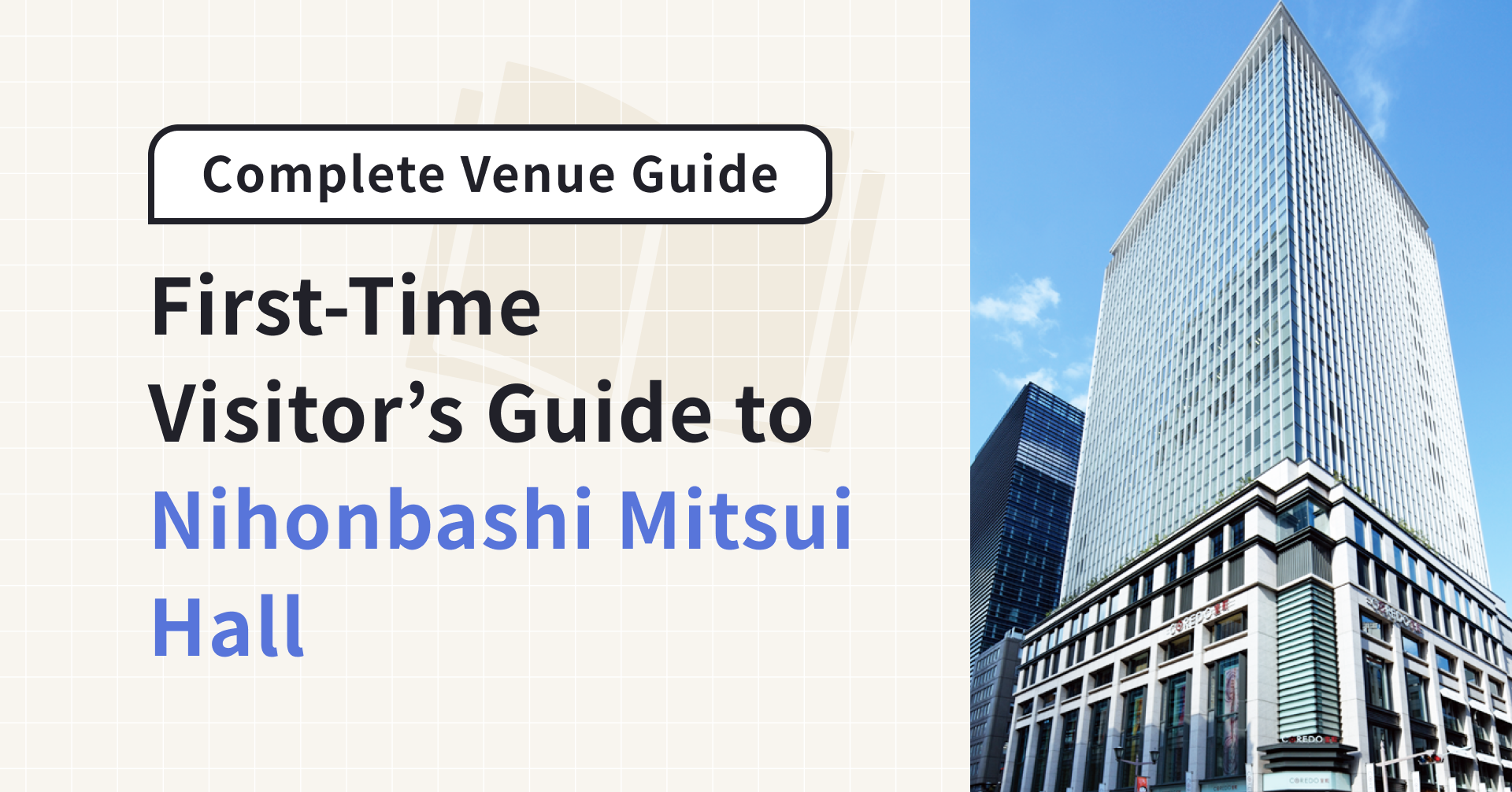
Your First Visit to Nihonbashi Mitsui Hall
Nihonbashi Mitsui Hall is a multipurpose event hall located on the 5th floor of COREDO Muromachi 1 in Nihonbashi Muromachi, Chuo City, Tokyo. Opened in 2010, it is situated in Nihonbashi, a district where tradition and innovation come together.
The venue is used for a wide range of events, from business events such as lectures, academic conferences, exhibitions, product launches, and parties to entertainment events including concerts, yose variety shows, and rakugo performances. Its flexible layout is a key feature: with retractable seating that can be set in three configurations, the same hall can be used for a lecture and then reconfigured for a networking reception afterward.
This guide covers how to get to Nihonbashi Mitsui Hall from the airports and major stations, carefully selected hotel recommendations for international visitors, long-standing dining spots nearby, and practical tips for the day of your event.
Use this guide to prepare for your visit to Nihonbashi Mitsui Hall and enjoy your event in the historic district of Nihonbashi.
Access Guide to Nihonbashi Mitsui Hall
Nihonbashi Mitsui Hall is exceptionally conveniently located, directly connected to Tokyo Metro Mitsukoshimae Station and JR Shin-Nihombashi Station, allowing you to reach the venue without getting wet, even on rainy days. It is also within walking distance of JR Tokyo Station and Kanda Station. Below are the routes from Narita and Haneda airports, along with directions from the nearest stations. Please check each official website for the latest information.
Nearest Stations and Exits for Nihonbashi Mitsui Hall
The hall is within walking distance of several public transit stations. On the day of your event, the easiest route is usually to follow the flow of people from Exit A6 of Tokyo Metro Mitsukoshimae Station or from JR Shin-Nihombashi Station (official website).
Tokyo Metro Ginza Line / Hanzomon Line Mitsukoshimae Station (Exit A6)
COREDO Muromachi 1 is directly in front of you when you exit from Exit A6. Take the elevator or escalator to the 4th-floor entrance. You can reach the venue without going outside, even on rainy days.
Walking time: 0 minutes, directly connected (official website)
JR Sobu Rapid Line / Yokosuka Line Shin-Nihombashi Station
Directly connected by underground passage — follow the passage toward Tokyo Metro Mitsukoshimae Station. Because the route is connected underground, you can reach the venue without getting wet.
Walking time: Approx. 4 minutes (official website)
JR Tokyo Station / Kanda Station
From the Nihonbashi Exit of Tokyo Station, cross Tokiwabashi Bridge, pass in front of the Bank of Japan, and head toward Mitsukoshimae. From the East Exit of Kanda Station, walk along Chuo-dori toward Nihonbashi.
Walking time: Approx. 9 minutes (official website)
From Narita Airport
- Airport Limousine Bus: Approximately 55–90 minutes. Take an airport limousine bus from Narita Airport bound for Tokyo City Air Terminal (T-CAT) or Tokyo Station. T-CAT is located in Nihonbashi-Hakozaki, about 10 minutes from the hall by taxi. If you get off at Tokyo Station, the hall is about a 9-minute walk from the Nihonbashi Exit.
- Train (JR Narita Express): Approximately 53–60 minutes. Take the Narita Express from Narita Airport Station to JR Tokyo Station in about 60 minutes. From the Nihonbashi Exit of Tokyo Station, Nihonbashi Mitsui Hall is about a 9-minute walk. Alternatively, transfer at Tokyo Station to the Tokyo Metro Ginza Line and get off at Mitsukoshimae Station, which is directly connected to the venue via Exit A6.
- By Car (Taxi): Travel time varies significantly depending on traffic. Via the Kandabashi Exit on the Metropolitan Expressway Inner Circular Route, the trip takes about 60–90 minutes. This is convenient if you have a lot of luggage or are traveling in a group, but during heavy traffic, the limousine bus or train may be more reliable.
From Haneda Airport
- Airport Limousine Bus: Approximately 25–40 minutes. Take an airport limousine bus from Haneda Airport to Tokyo City Air Terminal (T-CAT). From T-CAT, Nihonbashi Mitsui Hall is about 10 minutes by taxi.
- Train (Keikyu + Subway): Approximately 45 minutes. From Haneda Airport Station, take the Keikyu Line to Nihombashi Station via direct service on the Toei Asakusa Line. Transfer at Nihombashi Station to the Tokyo Metro Ginza Line and get off at Mitsukoshimae Station, directly connected to the venue via Exit A6. You can also walk from Nihombashi Station in about 8 minutes.
- By Car (Taxi): Travel time varies significantly depending on traffic. Via the Kandabashi Exit on the Metropolitan Expressway Inner Circular Route, the trip takes about 30–50 minutes. This option is well suited for early-morning or late-night travel when traffic is lighter.
Venue Information Summary
- Official name: Nihonbashi Mitsui Hall
- Address: COREDO Muromachi 1, 5F (Entrance on 4F), 2-2-1 Nihonbashi Muromachi, Chuo City, Tokyo 103-0022
- Nearest station: Directly connected to Exit A6 of Mitsukoshimae Station (Tokyo Metro Ginza/Hanzomon Line)
- Official website: https://www.nihonbashi-hall.jp/
Recommended Hotels Near Nihonbashi Mitsui Hall
This section contains affiliate links.
The Nihonbashi area offers a wide range of accommodations where international visitors can stay comfortably, from luxury hotels to highly convenient city hotels. We have selected five hotels with a particular focus on convenient access to the venue.
Mandarin Oriental, Tokyo
Directly connected to Exit A7 of Mitsukoshimae Station, this property is located on the 30th to 38th floors of the Nihonbashi Mitsui Tower — one of the world’s leading luxury hotels. Guided by the concept of a “sense of place,” the hotel features interiors that incorporate Japanese aesthetics, and all 179 guest rooms offer at least 50m² of space. With a spa and 12 restaurants and bars, including Michelin-starred dining, it offers a truly premium stay.
Mitsui Garden Hotel Nihonbashi Premier
A 1-minute walk from Exit A10 of Mitsukoshimae Station. This hotel is designed around the concept of creating “a hotel that stays in your memory,” with thoughtful touches throughout that let guests experience the refined character of Nihonbashi. Facilities include a large public bath scented with hinoki cypress, the Kaga cuisine restaurant Nihonbashi Asada, and the authentic BAR Matsu. On the first floor, the Nihonbashi Information Counter offers multilingual assistance from staff in kimono, offering extra peace of mind for international guests.
Royal Park Hotel
Directly connected to Suitengumae Station on the Tokyo Metro Hanzomon Line and adjacent to Tokyo City Air Terminal (T-CAT), where airport limousine buses arrive and depart. This 20-story high-rise hotel has 419 rooms, and Executive Floor guests have access to a lounge on the 20th floor. Facilities include nine restaurants and bar lounges, a fitness club, a Japanese garden and tea room, and Royal Park Spa by L’OCCITANE Tokyo.
Hotel Ryumeikan Tokyo
A 3-minute walk from the Yaesu North Exit of Tokyo Station. This next-generation hotel carries on the legacy of a long-established ryokan founded in 1899. Its appeal lies in its variety of modern, calming guest rooms inspired by the traditional Japanese color Edo purple. There are 12 room types in total, including the concept room “FORUS” and a Japanese Junior Suite with tatami flooring. The Japanese and Western breakfast buffet at Hanagoyomi Tokyo on the 15th floor is also well regarded.
Mitsui Garden Hotel Kyobashi
A 5-minute walk from the Yaesu Central Exit of Tokyo Station. This city hotel is close to both the Nihonbashi and Ginza areas. The hotel offers a comfortable night’s sleep with original pillows co-developed with Lofty, a pioneer in sleep pillows, and Serta hotel mattresses with pocket coils. In the guest lounge on the 2nd floor, guests can enjoy complimentary coffee from a self-service coffee machine and snacks.
▶ See 10 Recommended Hotels near Nihonbashi Mitsui Hall
Recommended Restaurants Near Nihonbashi Mitsui Hall
Nihonbashi has flourished since the Edo period as a gourmet district known for bringing together excellent food. Around the venue, you will find everything from famous restaurants with long lines to hidden long-standing gems that international visitors should try. Here are six recommended genres within walking distance of Nihonbashi Mitsui Hall.
Tendon
Nihonbashi Tendon Kaneko Hannosuke Nihonbashi Main Store
A 1-minute walk from Mitsukoshimae Station. A famous tendon restaurant known for its bold Edomae-style tendon, with lines forming day after day. Topped generously with conger eel, shrimp, squid kakiage, soft-boiled egg, and nori, then finished with the restaurant’s secret donburi sauce, this bowl is the very definition of hearty Edomae flavor. Although it opened relatively recently in 2010, it has become one of Nihonbashi’s most iconic popular restaurants.
Oden
Heichan
About a 3-minute walk from Exit A1 of Mitsukoshimae Station, this creative Japanese restaurant is located in the basement of a building in Nihonbashi Muromachi. Run by the team behind a Michelin-starred French restaurant, it serves oden reimagined as a refined dish, built on traditional dashi techniques. It blends long-standing Japanese flavors with a modern sensibility, and pairs well with champagne and wine.
Kaisendon
Nihonbashi Kaisendon Tsujihan Muromachi Store
Located in the very same building as the venue, on the 1st floor of COREDO Muromachi 1, this is a sister restaurant of Tsujihan. Like the Nihonbashi main store, it serves the lavish Zeitaku Don, allowing you to enjoy Edo-style indulgence in a casual setting in a dining space facing Edo Sakura-dori Avenue. With excellent access to the venue, it is ideal for a meal before or after an event.
Cafe / Castella
BUNMEIDO CAFE Bunmeido Nihonbashi Main Store
A 1-minute walk from Mitsukoshimae Station. A cafe restaurant operated by Bunmeido, a long-established castella maker founded in Nagasaki in 1900. Based on the concept of “Japanese and Western, past and present, people and people,” the cafe serves its signature premium castella, freshly made Mikasa pancakes made with the batter used for its Mikasa-yama dorayaki, as well as lunch dishes such as curry and pasta.
Sushi
Sushi Nihonbashi Seamon
Located in the very same building as the venue, on the 4th floor of COREDO Muromachi 1, this Edomae sushi restaurant is an offshoot of a popular Ginza sushi shop. In addition to nigiri finished with three types of nikiri soy sauce chosen to match each ingredient, the menu goes beyond typical sushi fare with seasonal dishes and sake pairings. With around 50 varieties of champagne and wine available, it’s also well suited to business dinners.
Unagi
Nihonbashi Unagi Idumoya
About a 3-minute walk from Exit A8 of Mitsukoshimae Station, along Edo-dori Avenue, this long-established eel restaurant was founded in 1946. The first floor has table seating, while the second floor offers tatami rooms suited to entertaining and business dinners, all within the restaurant’s calm, time-honored atmosphere.
Wi-Fi and Facilities at Nihonbashi Mitsui Hall
- Internet Connection: Each green room is equipped with 200Mbps high-speed wired LAN (shared with the internal phone and intercom lines). No Wi-Fi service could be confirmed (Nihonbashi Mitsui Hall official website equipment list PDF).
- Smoking Area: A smoking area (with a smoke-separating unit) is located on the 5th floor (Nihonbashi Mitsui Hall official website facility overview).
- Hours & Extensions: For exhibitions and similar facility use, hours run 9:00-21:00, with a base fee of ¥1,800,000 (excl. tax), a setup-day fee of ¥1,200,000 (excl. tax), and extension fees of ¥180,000/hour within hours or ¥200,000/hour outside hours (excl. tax). For concerts and other entertainment use, the base fee is ¥710,000 (excl. tax), with extensions at ¥71,000/hour (excl. tax) (Nihonbashi Mitsui Hall official website price list PDF).
- Parking: There is no dedicated parking; visitors use the “COREDO Muromachi Parking” in the basement of COREDO Muromachi 2. Hours are 6:00-26:00 (vehicles must exit within operating hours), the rate is ¥250 per 30 minutes (no cap, no discounts), and vehicle size limits are 2.0m height, 1.95m width, 5.3m length, and 2,300kg weight (Nihonbashi Mitsui Hall official website access page).
- Loading and Unloading: A loading elevator (interior W2,900mm x D2,000mm x H3,000mm, capacity 3,000kg) is available. The B3F loading dock accepts vehicles up to a 2-ton short truck, with 30 minutes of free parking (1 space on weekdays, 3 spaces on weekends/holidays) (Nihonbashi Mitsui Hall official website loading route guide PDF).
- Accessibility: A multi-purpose restroom is available near the 5th-floor foyer (Nihonbashi Mitsui Hall official website 5F floor plan PDF).
- Cloakroom: A cloakroom space of about 13 tsubo (approx. 45m²) is located on the 4th floor (Nihonbashi Mitsui Hall official website facility overview).
- Outside Food and Drinks: Under Article 9(15) of the terms of use, eating, drinking, or smoking is prohibited outside locations designated by the operator (Nihonbashi Mitsui Hall terms of use PDF).
Tips Before You Visit
The entrance is on the 4th floor, and the hall is on the 5th floor
Nihonbashi Mitsui Hall is located on the 5th floor of COREDO Muromachi 1, and the entrance is on the 4th floor. When you arrive, please check in at the 4th-floor entrance before proceeding to the hall on the 5th floor (official site).
You can arrive without getting wet, even on rainy days
Exit A6 of Tokyo Metro Mitsukoshimae Station and JR Shin-Nihombashi Station are directly connected to COREDO Muromachi 1 by underground passages. Being able to reach the venue without going outside is a major advantage on rainy or snowy days (official site).
On event days, follow the flow of people
During large events, the area around Mitsukoshimae Station and the elevators may become crowded before doors open and after the event ends. We recommend following the flow of people from the nearest exit on the day of your visit (official site).
Event Venues at Nihonbashi Mitsui Hall
Nihonbashi Mitsui Hall is a venue that can be reserved in full, from the 4th-floor entrance to the 6th-floor dressing rooms. The 5th-floor foyer, overlooking Chuo-dori, can also be used as a business meeting space or party space. The floor area and ceiling height of each space are as follows.
Specifications
| Space | Floor | Area | Dimensions / Ceiling Height | Capacity / Notes |
|---|---|---|---|---|
| Hall | 5F | 212 tsubo / 704m² (192 tsubo / 636m² seats retracted) | W20.5m × D34.0m / Ceiling 7.0m | Theater-style: up to 690 / Classroom-style: up to 432 |
| Foyer | 5F | 87 tsubo / 288m² | 44.0m × 3.9m / 3.0m | Carpet flooring |
| Entrance | 4F | 34 tsubo / 115m² | 3.0m (partly 3.5m) | Stone flooring |
| Dressing Room (5F) | 5F | 13 tsubo / 44m² | - | Divisible into two |
| Dressing Rooms (6F) | 6F | 6 tsubo / 23m² and 8 tsubo / 27m² | - | 2 rooms |
| Elevating Stage | 5F (in hall) | - | W16.4m × D6.0m / 0–1,200mm | Black/side curtains |
Source: Nihonbashi Mitsui Hall Facility Overview
Additional equipment in the 5th-floor hall includes three motorized trusses, ten motorized lighting battens, two scenery battens, one roll screen, and two motorized speaker grids. Concert-ready equipment allows for a wide range of productions, including digital audio signals, line-array speakers, sound-absorbing hall design, a 400-inch widescreen, and motorized truss equipment above the stage.